

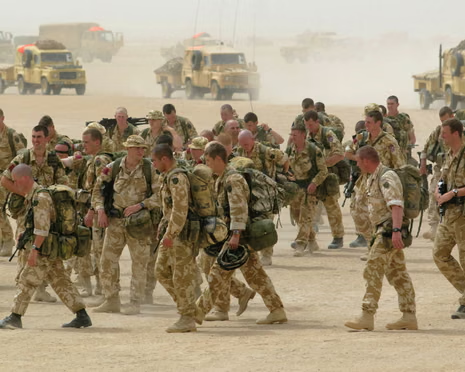
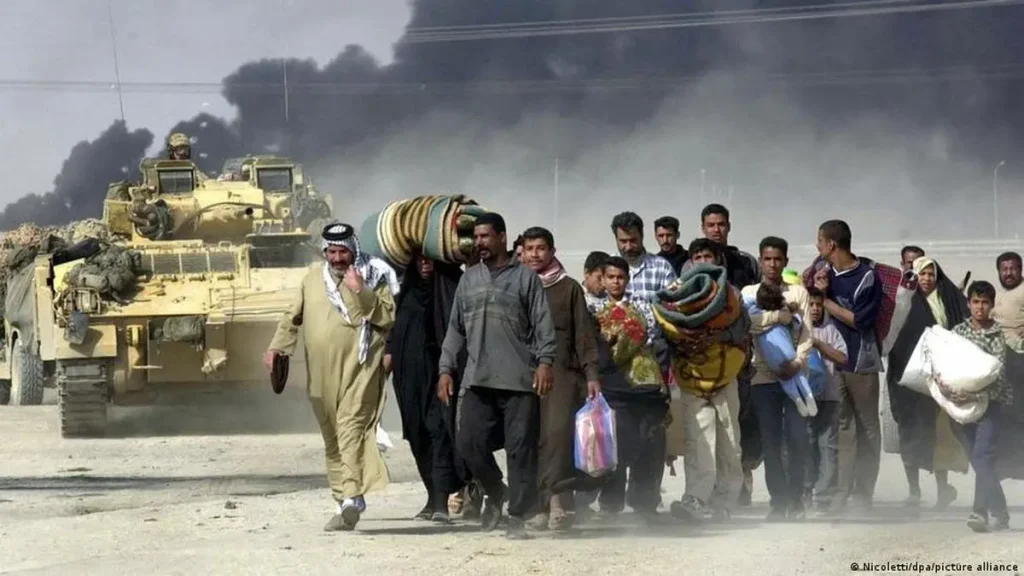
The invasion of March 2003 was a catastrophe for Iraq and its people.
More proof of that, measured in broken lives, was at a suspected site of a mass grave in the desert outside Sinjar, not far from the border with Syria.
Survivors of one of Iraq’s damaged communities, the Yazidis, looked on as the earth in a marble quarry was excavated. On a wire fence around the site were photos of dozens of people, mostly men, who had been killed by jihadists from the Islamic State group. They were from Zile-li, a village near the quarry, where 1,800 men were taken and killed on 3 August 2014.
The Yazidis revere both the Quran and the Bible; their religion is influenced by both Christianity and Islam. Islamic State considered them to be infidels and carried out a genocidal assault. It happened after the Americans and British had ended their occupation, but a direct line links the massacre to the invasion, and the disastrous years that followed.
Among those watching the excavation was Naif Jasso, the Sheikh of Kocho, a Yazidi community that suffered an even worse attack than Zile-li. He said that in Kocho, 517 people out of a population of 1,250 were killed by jihadists from IS, also known as ISIS or Daesh.
In Zile-li, men were separated from their families at gunpoint and shot dead at the quarry. Sofian Saleh, who was 16 at the time, was among the crowd at the excavation. He is one of only two men from Zile-li who survived. As he waited for death with his father, brother and 20 to 30 other men, he saw another group shot dead. Their bodies tumbled down a cliff into the quarry. Then it was their turn.
“They tied our hands from behind before the shooting. They took us and threw us on the ground,” he said.
Sofian’s father and brother were killed, but he survived because bodies fell on him, covering him up.
Islamic State was using its favourite tactic. First, they killed the men, then took the women as slaves. Children were removed from their mothers to be indoctrinated as IS recruits. A mother sitting near the suspected grave wept as she remembered the baby ripped from her and given to a jihadist family.
Next to the wire fence around the site, Suad Daoud Chatto, a woman in her 20s, stood with a poster. On it were the faces of nine men from her extended family who were killed, and two missing female relatives. She said jihadists captured her in 2014 when she was 16, along with many other women and girls, and held her in Syria. She remained until 2019, when she was rescued as the Caliphate collapsed.
“They were like barbarians, they kept us in handcuffs for a long time. Our hands were still tied even during the meals,” she said.
“They married me off many times… they were marrying the slaves. They did not spare anyone. We were all raped. They were killing people before our eyes. They killed all the Yazidi men – they killed eight of my uncles. They destroyed many families.”
In the end, only a few bags of human bones were found at the site. Dozens of others are still to excavated.
By the time IS rampaged through Iraq in the summer of 2014, the US and the UK had ended their occupation. Jihadist ideology existed long before the invasion, and had inspired the 9/11 attacks.
But far from destroying the ideology of Osama Bin Laden and the jihadist extremists, the years of chaos and brutality set off in 2003 turbo-charged murderous jihadist violence. Al-Qaeda, broken for a while by an alliance between the Americans and Sunni tribes, regenerated into the even more barbarous IS.
Iraq is more stable so far this year than it has been for a long while. Baghdad, Mosul and other cities are much safer. But Iraqis feel the results of the invasion every day. Its consequences have shaped and blighted millions of lives and changed their country profoundly.
It is a grim irony that the invasion has dropped out of political and public debate in the US, which conceived and led it, and in the UK, its closest ally in the coalition. The Americans and British bear a heavy responsibility for what happened after the invasion, and its consequences also affect them.
Iraq’s tyrant, Saddam Hussein, was well worth overthrowing – he had imprisoned and killed thousands of Iraqis, even using chemical weapons against rebellious Kurds. The problem was how it was done, the way the US and UK ignored international law, and the violence that gripped Iraq after the Bush administration failed to make a plan to fill the power vacuum created by regime change.
The past 20 years since the invasion, coming on top of Saddam’s dictatorship, add up to almost half a century of torture for the Iraqi people.
Even for those who were there, it is hard to recreate the febrile atmosphere of “fear, power and hubris”, as one historian put it recently, that gripped the US in the 18 months between al-Qaeda’s 9/11 attacks in 2001 and the invasion of Iraq.
I was in New York a few days after the Twin Towers of the World Trade Center were destroyed, as F-15 jets patrolled above Manhattan. It was a visible demonstration of American force, as the biggest military power on the planet worked out how to respond.
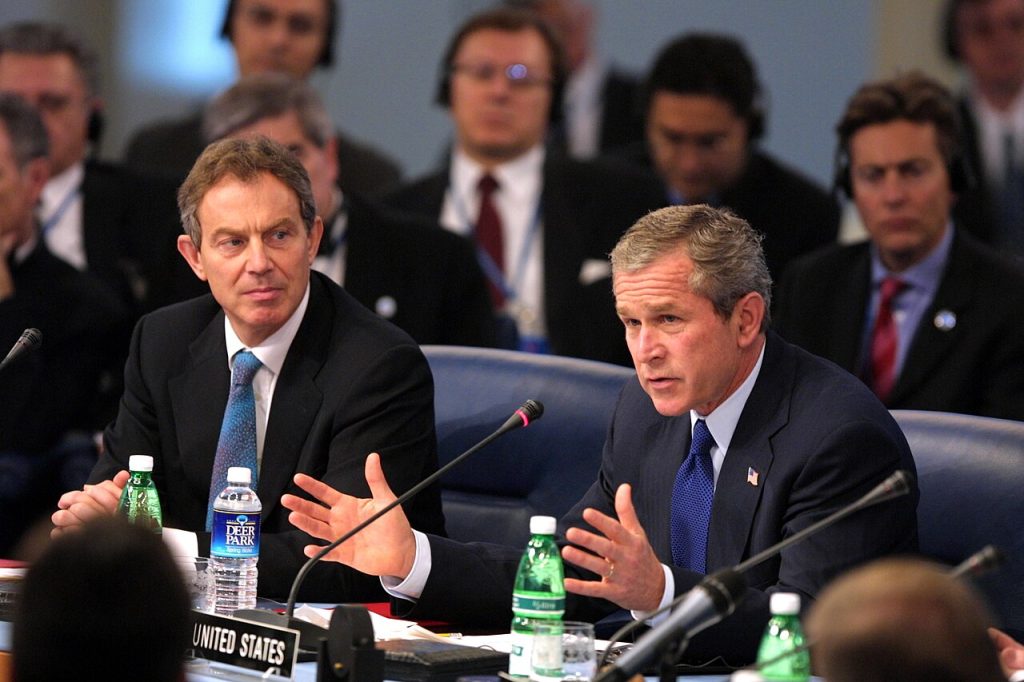
The shock of the attacks swiftly produced George W Bush’s declaration of “war on terror” against al-Qaeda and its jihadist fellow travellers. UK Prime Minister Tony Blair chartered Concorde to cross the Atlantic to offer support. He believed Britain’s best guarantee of influence in the world was to stay close to the White House.
They moved fast against al-Qaeda’s network in Afghanistan. Before the end of the year, a US-led coalition removed the Taliban regime from power when it refused to give up al-Qaeda’s leader, Osama Bin Laden. Kabul was not enough for America.
President Bush and his advisors saw a global threat to the US. They thought states that opposed them could make deadly alliances with al-Qaeda and its imitators. The biggest target in their sights was Iraq. Saddam Hussein had been a thorn in America’s side ever since he sent his army into Kuwait in 1990. Without any evidence, the Americans tried to manufacture a link between Saddam and al-Qaeda when none existed. In reality the Iraqi leader, a secular dictator, saw religious extremists as a threat.
The president’s father, George HW Bush, decided not to remove Saddam from power in Baghdad after the Iraqi occupiers were driven out of Kuwait by an international coalition assembled by the US in 1991. The first President Bush and his advisors saw trouble ahead if they continued to Baghdad. A long, belligerent occupation of Iraq looked like a morass and they had no UN authorisation to topple the regime.
I was in Baghdad when the ceasefire was declared. Regime officials I knew could not believe that Saddam’s dictatorship had survived.
Twelve years later, by 2003, America’s rage and arrogance of power blinded the second President Bush to the realities that had constrained his father. When the US and UK could not persuade the UN Security Council to pass a resolution explicitly authorising invasion and regime change, Messrs Bush and Blair claimed earlier resolutions gave them the authority they needed.
Among many who did not buy their argument was the UN Secretary-General Kofi Annan. In a BBC interview 18 months after the invasion, he said it was “not in conformity” with the UN Charter – in other words, illegal. France and other Nato allies refused to join the invasion. Tony Blair ignored huge protests in the UK. His decision to go to war dogged the rest of his political career.
No president or prime minister faces a bigger decision than going to war. George Bush and Tony Blair embarked on a war of choice that killed hundreds of thousands of people. The justifications for the invasion were soon shown to be untrue. The weapons of mass destruction that Tony Blair insisted, eloquently, made Saddam a clear and present danger, turned out not to exist. It was a failure not just of intelligence but of leadership.
The Americans called the huge air raids that started their offensive “shock and awe”. Neo-conservatives around George W Bush deluded themselves that democracy, and regional stability, could be imposed through the barrel of a gun. Overwhelming US force would not just safeguard America, it would stabilise the Middle East too, and democracy would spread through Syria, Iran and beyond, like a good virus.