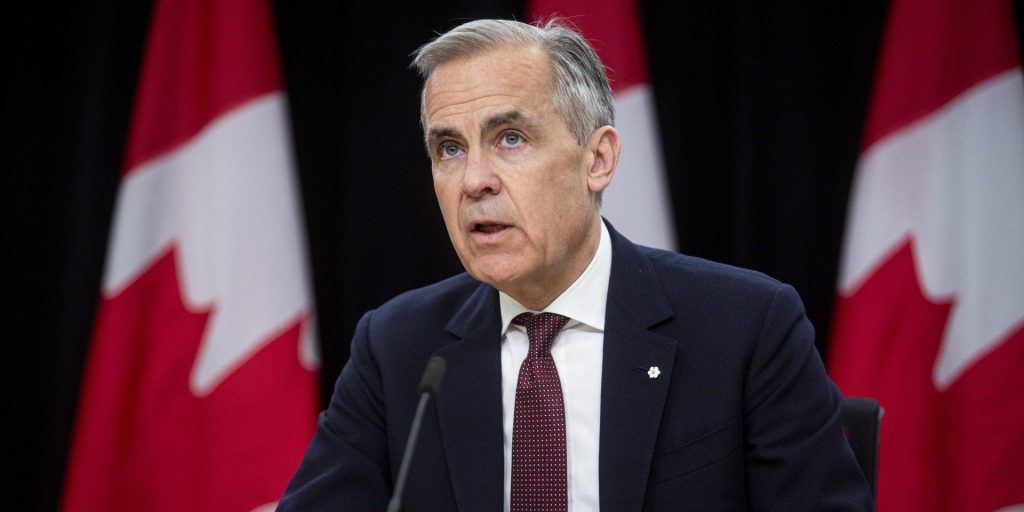
Canada’s Prime Minister Mark Carney is en route to China for a pivotal visit aimed at resetting ties with Beijing and finding new economic opportunities for his country outside the US.
It will not be an easy task, with pressure on Canada to balance its goal of diversifying trade without risking damage to its relationship with Donald Trump or compromising national security and human rights commitments.
But with ongoing uncertainty over Canada’s trade future with the US – its largest customer – the country now finds itself seeking to repair strained relations to protect its economy.
Senior Canadian officials have described the trip, the first to China by a Canadian prime minister since 2017, as “consequential and historic” and part of a “bold” plan to double Canada’s non-US exports over the next decade.
Trade will be on the agenda, along with agriculture and international security, Carney’s office said. Beijing’s foreign ministry said the two countries have “shared interests” and should work to “increase people-to-people ties and cultural exchanges”.
On Thursday, Carney meets the Premier of China, Li Qiang, as well as the Chairman of the Standing Committee of the National People’s Congress of China, Zhao Leji.
On Friday, the prime minister is scheduled to meet Chinese President Xi Jinping one-on-one, after the pair met last year on the sidelines of an Asia-Pacific Economic Cooperation summit in South Korea.
This official visit is a significant step in the rapprochement after Canada-China relations hit a low in 2018, following the arrest of Huawei executive Meng Wanzhou in Vancouver on a US warrant on fraud charges related to Iran sanctions violations.
The detention in Canada of the executive of a Chinese telecom giant angered Beijing, and China subsequently arrested two Canadians on espionage charges.
All three were released in 2021 after Meng cut a deal with US prosecutors.
More recently, China has been accused of meddling in Canada’s politics, though a public inquiry on foreign interference found its impact in recent federal elections to be minimal. China has repeatedly denied allegations of foreign meddling.
Canada and China have struggled to forge meaningful ties in the past.
The Carney government does not see this upcoming visit as a deviation from that view, senior Canadian government officials told reporters this week. But they added that Canada cannot achieve its objective of reducing economic reliance on the US without increasing trade with China.
Carney is said to be approaching talks with an eye on increasing collaboration in areas of mutual interest like energy and climate, and putting guardrails on areas where the two countries clash, like defence and critical minerals.
“I think we are approaching the relationship now with the realism that we haven’t seen for decades,” Colin Robertson, a former Canadian diplomat, told the BBC.
Robertson added that it could result in a “healthier relationship if both sides understand where they’re coming from and what the red lines are”.
It has already proven to be a careful line to walk. Ahead of Carney’s visit, two Liberal MPs cut a sponsored trip to Taiwan short, telling the Globe and Mail newspaper that while Canada’s position on Taiwan “has not changed”, the trip ended early to “avoid confusion with its foreign policy, given the overlap with the Prime Minister’s engagement in Beijing”.
One of Canada’s main objectives during this trip is to ease Chinese tariffs on Canadian canola that have hurt farmers in the country’s prairie provinces.
China last year imposed the agriculture tariffs in a move widely seen as retaliation for Canadian levies on Chinese electric vehicles announced in 2024, mirroring similar levies by the US.
In an editorial this week, state-run newspaper Global Times pointed to frustration expressed by Canadian farmers, suggesting “perhaps this was the heavy price (Canada) paid for blindly following the US”. China has made it clear it wants the tariffs on EVs lifted.
For China, Canada is seen as an important trading partner, with trade between the two countries valued at around $118bn in 2024. But crucially for Beijing, if President Xi manages to make a deal with Carney, it would give China more influence in a country that is on America’s doorstep.
The Global Times op-ed called on Ottawa to set a foreign policy path separate from that of the US and to exercise “strategic autonomy”.
One big unknown about this visit is how the US would react to any deals struck between Canada and China. Canada’s economy has been hit by US tariffs, especially those on its steel, aluminium and automotive sectors. Talks to ease those levies remain on pause.
Canada will soon, however, be engaged in consequential talks on renewing a long-standing North American free trade agreement with the US and Mexico that has shielded it from the bulk of Trump’s sweeping tariffs. That review is set to be completed later this year.
Robertson, the former diplomat, said it is likely that the Americans are watching the Canada-China relationship “very closely”, and that Canada is keeping the US “well informed” of its intentions.
But he added: “At the end of the day, there’s Canadian interests that we’re pursuing.”
With additional reporting from Jessica Murphy in Toronto.
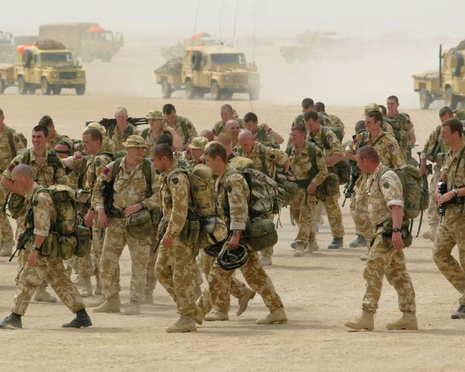
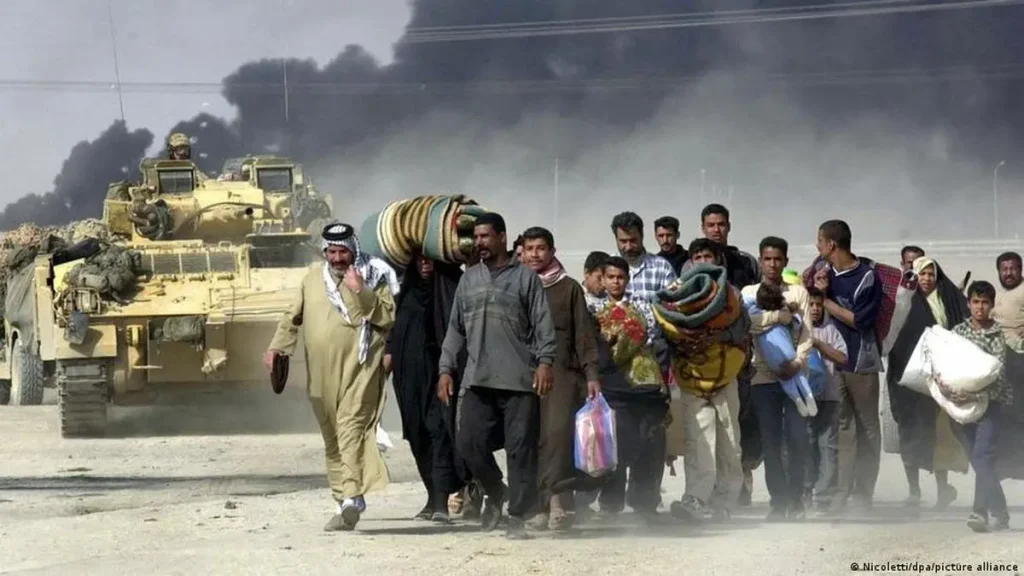
The invasion of March 2003 was a catastrophe for Iraq and its people.
More proof of that, measured in broken lives, was at a suspected site of a mass grave in the desert outside Sinjar, not far from the border with Syria.
Survivors of one of Iraq’s damaged communities, the Yazidis, looked on as the earth in a marble quarry was excavated. On a wire fence around the site were photos of dozens of people, mostly men, who had been killed by jihadists from the Islamic State group. They were from Zile-li, a village near the quarry, where 1,800 men were taken and killed on 3 August 2014.
The Yazidis revere both the Quran and the Bible; their religion is influenced by both Christianity and Islam. Islamic State considered them to be infidels and carried out a genocidal assault. It happened after the Americans and British had ended their occupation, but a direct line links the massacre to the invasion, and the disastrous years that followed.
Among those watching the excavation was Naif Jasso, the Sheikh of Kocho, a Yazidi community that suffered an even worse attack than Zile-li. He said that in Kocho, 517 people out of a population of 1,250 were killed by jihadists from IS, also known as ISIS or Daesh.
In Zile-li, men were separated from their families at gunpoint and shot dead at the quarry. Sofian Saleh, who was 16 at the time, was among the crowd at the excavation. He is one of only two men from Zile-li who survived. As he waited for death with his father, brother and 20 to 30 other men, he saw another group shot dead. Their bodies tumbled down a cliff into the quarry. Then it was their turn.
“They tied our hands from behind before the shooting. They took us and threw us on the ground,” he said.
Sofian’s father and brother were killed, but he survived because bodies fell on him, covering him up.
Islamic State was using its favourite tactic. First, they killed the men, then took the women as slaves. Children were removed from their mothers to be indoctrinated as IS recruits. A mother sitting near the suspected grave wept as she remembered the baby ripped from her and given to a jihadist family.
Next to the wire fence around the site, Suad Daoud Chatto, a woman in her 20s, stood with a poster. On it were the faces of nine men from her extended family who were killed, and two missing female relatives. She said jihadists captured her in 2014 when she was 16, along with many other women and girls, and held her in Syria. She remained until 2019, when she was rescued as the Caliphate collapsed.
“They were like barbarians, they kept us in handcuffs for a long time. Our hands were still tied even during the meals,” she said.
“They married me off many times… they were marrying the slaves. They did not spare anyone. We were all raped. They were killing people before our eyes. They killed all the Yazidi men – they killed eight of my uncles. They destroyed many families.”
In the end, only a few bags of human bones were found at the site. Dozens of others are still to excavated.
By the time IS rampaged through Iraq in the summer of 2014, the US and the UK had ended their occupation. Jihadist ideology existed long before the invasion, and had inspired the 9/11 attacks.
But far from destroying the ideology of Osama Bin Laden and the jihadist extremists, the years of chaos and brutality set off in 2003 turbo-charged murderous jihadist violence. Al-Qaeda, broken for a while by an alliance between the Americans and Sunni tribes, regenerated into the even more barbarous IS.
Iraq is more stable so far this year than it has been for a long while. Baghdad, Mosul and other cities are much safer. But Iraqis feel the results of the invasion every day. Its consequences have shaped and blighted millions of lives and changed their country profoundly.
It is a grim irony that the invasion has dropped out of political and public debate in the US, which conceived and led it, and in the UK, its closest ally in the coalition. The Americans and British bear a heavy responsibility for what happened after the invasion, and its consequences also affect them.
Iraq’s tyrant, Saddam Hussein, was well worth overthrowing – he had imprisoned and killed thousands of Iraqis, even using chemical weapons against rebellious Kurds. The problem was how it was done, the way the US and UK ignored international law, and the violence that gripped Iraq after the Bush administration failed to make a plan to fill the power vacuum created by regime change.
The past 20 years since the invasion, coming on top of Saddam’s dictatorship, add up to almost half a century of torture for the Iraqi people.
Even for those who were there, it is hard to recreate the febrile atmosphere of “fear, power and hubris”, as one historian put it recently, that gripped the US in the 18 months between al-Qaeda’s 9/11 attacks in 2001 and the invasion of Iraq.
I was in New York a few days after the Twin Towers of the World Trade Center were destroyed, as F-15 jets patrolled above Manhattan. It was a visible demonstration of American force, as the biggest military power on the planet worked out how to respond.
The shock of the attacks swiftly produced George W Bush’s declaration of “war on terror” against al-Qaeda and its jihadist fellow travellers. UK Prime Minister Tony Blair chartered Concorde to cross the Atlantic to offer support. He believed Britain’s best guarantee of influence in the world was to stay close to the White House.
They moved fast against al-Qaeda’s network in Afghanistan. Before the end of the year, a US-led coalition removed the Taliban regime from power when it refused to give up al-Qaeda’s leader, Osama Bin Laden. Kabul was not enough for America.
President Bush and his advisors saw a global threat to the US. They thought states that opposed them could make deadly alliances with al-Qaeda and its imitators. The biggest target in their sights was Iraq. Saddam Hussein had been a thorn in America’s side ever since he sent his army into Kuwait in 1990. Without any evidence, the Americans tried to manufacture a link between Saddam and al-Qaeda when none existed. In reality the Iraqi leader, a secular dictator, saw religious extremists as a threat.
The president’s father, George HW Bush, decided not to remove Saddam from power in Baghdad after the Iraqi occupiers were driven out of Kuwait by an international coalition assembled by the US in 1991. The first President Bush and his advisors saw trouble ahead if they continued to Baghdad. A long, belligerent occupation of Iraq looked like a morass and they had no UN authorisation to topple the regime.
I was in Baghdad when the ceasefire was declared. Regime officials I knew could not believe that Saddam’s dictatorship had survived.
Twelve years later, by 2003, America’s rage and arrogance of power blinded the second President Bush to the realities that had constrained his father. When the US and UK could not persuade the UN Security Council to pass a resolution explicitly authorising invasion and regime change, Messrs Bush and Blair claimed earlier resolutions gave them the authority they needed.
Among many who did not buy their argument was the UN Secretary-General Kofi Annan. In a BBC interview 18 months after the invasion, he said it was “not in conformity” with the UN Charter – in other words, illegal. France and other Nato allies refused to join the invasion. Tony Blair ignored huge protests in the UK. His decision to go to war dogged the rest of his political career.
No president or prime minister faces a bigger decision than going to war. George Bush and Tony Blair embarked on a war of choice that killed hundreds of thousands of people. The justifications for the invasion were soon shown to be untrue. The weapons of mass destruction that Tony Blair insisted, eloquently, made Saddam a clear and present danger, turned out not to exist. It was a failure not just of intelligence but of leadership.
The Americans called the huge air raids that started their offensive “shock and awe”. Neo-conservatives around George W Bush deluded themselves that democracy, and regional stability, could be imposed through the barrel of a gun. Overwhelming US force would not just safeguard America, it would stabilise the Middle East too, and democracy would spread through Syria, Iran and beyond, like a good virus.
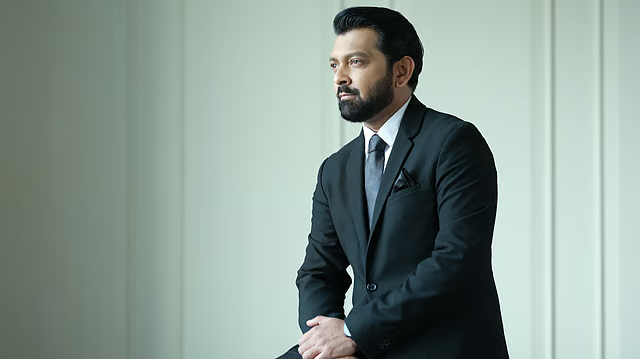
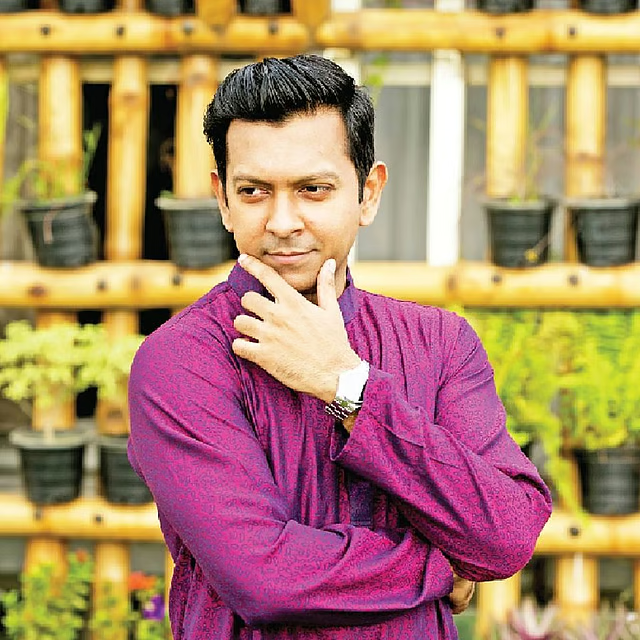
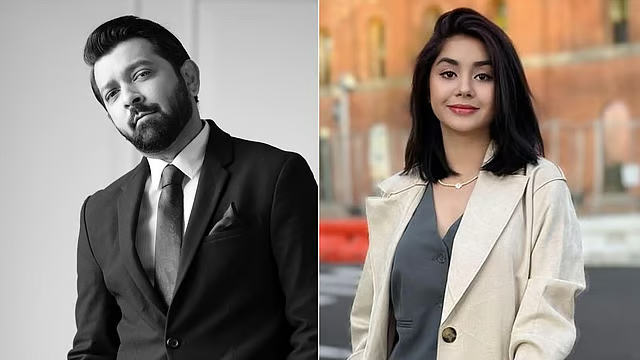
ঠিক এক বছর আগে সবাইকে চমকে দিয়ে বিয়ের খবর জানান জনপ্রিয় গায়ক ও অভিনয়শিল্পী তাহসান রহমান খান। যুক্তরাষ্ট্রপ্রবাসী রূপসজ্জাশিল্পী রোজা আহমেদের সঙ্গে তাঁর বিয়ে নিয়ে সে সময় বিনোদন অঙ্গনে ব্যাপক আলোচনা হয়। সামাজিক যোগাযোগমাধ্যমে টানা কয়েক দিন ট্রেন্ডিংয়ে ছিল তাহসানের বিয়ের খবর। তবে বছর না ঘুরতেই এলো বিচ্ছেদের সংবাদ। গত শনিবার প্রথম আলোকে তাহসান নিজেই তাঁদের বিচ্ছেদের বিষয়টি নিশ্চিত করেছেন।
বিচ্ছেদের খবরে স্বাভাবিকভাবেই নানা প্রশ্ন ঘুরপাক খাচ্ছে। তুমুল প্রেমের পর বিয়ে—তারপর এত দ্রুত সম্পর্কের সমাপ্তি কীভাবে সম্ভব, তা নিয়ে কৌতূহলী ভক্ত ও শুভানুধ্যায়ীরা। ঘনিষ্ঠ সূত্রগুলো জানাচ্ছে, প্রেমের সময়ের তুলনায় দাম্পত্য জীবনে একসঙ্গে থাকার সময়টা ছিল তুলনামূলকভাবে কম।
জানা গেছে, গত সেপ্টেম্বরে অস্ট্রেলিয়ায় সংগীতসফরে যাওয়ার আগেই তাহসান ও রোজা আলাদা থাকছিলেন। সে সময় মেলবোর্ন থেকে তাহসান গণমাধ্যমকে জানিয়েছিলেন গান ছেড়ে দেওয়ার সিদ্ধান্ত এবং সামাজিক যোগাযোগমাধ্যম থেকে নিজেকে গুটিয়ে নেওয়ার কথা।
গতকাল তাহসান জানিয়েছেন, ওই সময়েরও আগে থেকেই তাঁরা আলাদা ছিলেন। এরপর ব্যক্তিগত সম্পর্ক নিয়ে আর প্রকাশ্যে কোনো মন্তব্য করতে দেখা যায়নি তাঁকে। অন্যদিকে, রোজা বিভিন্ন সময়ে সামাজিক যোগাযোগমাধ্যমে তাহসানের সঙ্গে তোলা ছবি ও আবেগঘন পোস্ট শেয়ার করেছেন। এতে অনেকের ধারণা ছিল, সম্পর্কটি এখনো টিকে আছে। তবে ঘনিষ্ঠজনেরা বলছেন, বাস্তবতা ছিল ভিন্ন।
তাহসান খানছবি : প্রথম আলো
নাম প্রকাশ না করার শর্তে তাহসান ও রোজার ঘনিষ্টজনেরা জানিয়েছেন, বিয়ের পর দুজনের জীবনদর্শন ও প্রত্যাশার জায়গায় কিছু পার্থক্য স্পষ্ট হয়ে ওঠে। তাহসান চেয়েছিলেন আগের চেয়ে অনেক বেশি ব্যক্তিগত ও নিরিবিলি জীবনযাপন করতে। সে কারণেই বিনোদন অঙ্গন থেকে নিজেকে গুটিয়ে নেওয়া, সামাজিক যোগাযোগমাধ্যম নিষ্ক্রিয় করা—এমন সিদ্ধান্ত নেন তিনি। সংসারকেই দিতে চেয়েছিলেন অগ্রাধিকার।
অন্যদিকে, বিয়ের পর রোজার পরিচিতি ও সামাজিক পরিসর বেড়েছে। নতুন এই বাস্তবতাকে তিনি উপভোগ করছিলেন বলেও জানিয়েছেন সংশ্লিষ্টরা। এই ভিন্ন ভিন্ন মানসিক অবস্থান ও জীবনযাপনের ধারা ধীরে ধীরে দুজনের মধ্যে দূরত্ব তৈরি করে।
ঘনিষ্ঠ মহলের ভাষ্যমতে, শুরুতে এই দূরত্ব কাটিয়ে ওঠার চেষ্টা হলেও একসময় মতের অমিল প্রকট হয়ে ওঠে। কাউকে দোষারোপ না করে, পারস্পরিক সম্মানের জায়গা থেকে সম্পর্কের ইতি টানার সিদ্ধান্ত নেন দুজনই। জানা গেছে, গেল বছরের শেষ দিকেই বিচ্ছেদের আনুষ্ঠানিক প্রক্রিয়া সম্পন্ন হয়।
গত সেপ্টেম্বরে অস্ট্রেলিয়ায় সংগীতসফরে যাওয়ার আগেই তাহসান ও রোজা আলাদা থাকছিলেনকোলাজ
তাহসানের এটি দ্বিতীয় বিয়ে। আগের সংসারে তাঁর একটি কন্যাসন্তান রয়েছে, যার সঙ্গে তিনি নিয়মিত সময় কাটান। ব্যক্তিগত জীবন নিয়ে তাহসান বরাবরই সংযত। বর্তমান পরিস্থিতিতেও তিনি নীরবতাকেই বেছে নিয়েছেন।
ঘনিষ্ঠজনেরা জানিয়েছেন, বিচ্ছেদ হলেও দুজনই বিষয়টি সৌহার্দ্যপূর্ণভাবে সামলেছেন। সম্পর্ক জোড়া লাগার সম্ভাবনা নেই বলেই জানা গেছে। তবে কারও বিরুদ্ধে অভিযোগ নয়—বরং জীবন ও সম্পর্কের বাস্তবতায় ভিন্ন পথে এগোনোর সিদ্ধান্ত হিসেবেই দেখছেন তাঁরা।
যুক্তরাষ্ট্রের সেনারা ভেনেজুয়েলায় হামলা চালিয়ে দেশটির প্রেসিডেন্ট নিকোলাস মাদুরো ও তার স্ত্রী, ফার্স্ট লেডি সিলিয়া ফ্লোরেসকে ‘আটক’ করেছে।
মাদুরো ও তার স্ত্রীকে ইতোমধ্যে যুক্তরাষ্ট্রে নেওয়া হয়েছে এবং তাদেরকে ‘আমেরিকান বিচারের মুখোমুখি’ করা হবে বলে জানিয়েছেন মার্কিন প্রেসিডেন্ট ডোনাল্ড ট্রাম্প।
ট্রাম্প প্রশাসন বহুদিন ধরে অভিযোগ করে আসছে যে, মাদুরো সরকার যুক্তরাষ্ট্রে মাদক ও গ্যাং সদস্য পাঠাচ্ছে। এ নিয়ে ভেনেজুয়েলার ওপর নানারকম চাপ প্রয়োগের পর মার্কিন এই অভিযানের ঘটনা ঘটল।
ভেনেজুয়েলা পরিচালনার ঘোষণা ট্রাম্পের
ভেনেজুয়েলার প্রেসিডেন্ট নিকোলাস মাদুরো এবং তার স্ত্রীকে আটকের পর ‘আমেরিকান বিচারের মুখোমুখি’ করার জন্য নিউ ইয়র্কে নিয়ে আসা হচ্ছে বলে জানিয়েছেন মার্কিন প্রেসিডেন্ট ডোনাল্ড ট্রাম্প।
মার-এ-লাগোসে দেওয়া সংবাদ সম্মেলনে তিনি বলেন, তাদের এখন নিউইয়র্কে নিয়ে আসা হচ্ছে। সেখানে তারা আমেরিকান বিচারের মুখোমুখি হবেন।
যুক্তরাষ্ট্র “ভেনেজুয়েলা ও তার নেতার বিরুদ্ধে বৃহৎ পরিসরের হামলা সফলভাবে সম্পন্ন করেছে”
মাদুরো ও তার স্ত্রীকে আটক করে মার্কিন যুদ্ধজাহাজে করে নিউ ইয়র্কে নিয়ে আসা হচ্ছে
“ভেনেজুয়েলায় ক্ষমতার শান্তিপূর্ণ রদবদল না হওয়া পর্যন্ত আমরাই দেশটি চালাবো,” বলে মন্তব্য করেছেন মার্কিন প্রেসিডেন্ট ডোনাল্ড ট্রাম্প।
বর্তমানে যারা রয়েছে, তাদের সরিয়ে দিয়ে ভেনেজুয়েলা পরিচালনা করার জন্য লোকজন মনোনীত করার কাজ চলছে বলে তিনি জানান।
“প্রয়োজনে আরও বড় পরিসরে দ্বিতীয় দফায় আক্রমণের প্রস্তুতি রেখেছি আমরা,” বলেন তিনি।
বাংলাদেশ ক্রিকেট দলের ভারতে বিশ্বকাপ খেলতে যাওয়ার ইস্যুতে আইসিসির নিরাপত্তা বিভাগ ‘তিনটি আশঙ্কা’র কথা জানিয়ে চিঠি পাঠিয়েছে বলে সোমবার বিকেলে এক সংবাদ সম্মেলনে জানান বাংলাদেশের অন্তর্বর্তী সরকারের ক্রীড়া উপদেষ্টা আসিফ নজরুল। বিসিবিও একটি বিবৃতিতে নিশ্চিত করেছে যে, আইসিসি ও বিসিবির মধ্যে নিরাপত্তা ইস্যুতে অভ্যন্তরীণ একটি যোগাযোগের অংশ ওই চিঠি।
সেই চিঠিটি বিবিসি বাংলার হাতে এসেছে।
চিঠিটি মূলত একটি ইমেইল, যেটি আইসিসির সিকিউরিটি ম্যানেজার বা নিরাপত্তা বিভাগের ব্যবস্থাপক পাঠিয়েছেন বাংলাদেশ ক্রিকেট বোর্ডের নিরাপত্তা বিষয়ক উপদেষ্টাকে। মেইলটি পাঠানো হয়েছে ৮ই জানুয়ারি।
বাংলাদেশ ক্রিকেট দল এবং বাংলাদেশের সমর্থকরা ভারতে বিশ্বকাপে অংশ নিতে গেলে কী ধরনের ঝুঁকি তৈরি হতে পারে, মূলত সেটিই মেইলের বিষয়বস্তু। মেইলে বাংলাদেশ টিমের ‘রিস্ক অ্যাসেসমেন্ট সামারি’ বা ঝুঁকি মূল্যায়ন করে তার সারাংশ জানিয়েছেন আইসিসির সিকিউরিটি ম্যানেজার।
সাধারণত, আইসিসি যে কোনো আসর আয়োজনের ক্ষেত্রে এই ধরনের ‘রিস্ক অ্যাসেসমেন্ট’ বা ঝুঁকি মূল্যায়ন করে থাকে, যেখানে পুরো আসরের আগে ঝুঁকির মাত্রা মূল্যায়নের পাশাপাশি প্রতিটি ভেন্যুকে ঘিরে প্রতিটি দলের ঝুঁকির মাত্রা নির্ধারণ করা হয়। এই ঝুঁকি মূল্যায়নের পর সাধারণত প্রতিটি দলের জন্য প্রতিবেদন দেয়া হয়।
যা রয়েছে আইসিসির মেইলে
মেইলের শুরুতে তেসরা জানুয়ারি মোস্তাফিজুর রহমানকে বাদ দিতে বিসিসিআইয়ের নির্দেশনা, নিরাপত্তা ইস্যুতে বাংলাদেশ ক্রিকেট বোর্ডের ভারতের বদলে শ্রীলঙ্কায় খেলতে চাওয়ার দাবি এবং মোস্তাফিজকে বাদ দেওয়ার ইস্যুকে কেন্দ্র করে বাংলাদেশে আইপিএলের সম্প্রচার বন্ধ করার বিষয়টি উল্লেখ করা হয়েছে।
এরপর চারটি বিষয়ে আলাদা করে বাংলাদেশ দলের ভারত সফরের ঝুঁকির মূল্যায়ন করা হয়েছে।